Sunday, February 9, 2014

Snow Day Make Ups Could Be Better than the Original

Having a true winter has thrown many schools for a loop; wouldn't it be ironic if this is the impetus to truly innovate some aspects of education? One of my favorite professional reads has been Disrupting Class: How Disruptive Innovation Will Change the Way the World Learns by Clayton Christensen, Curtis W. Johnson, and Chris Horn. A key point I took from it is that "disruption" does not refer to a change that takes the place of something else, it offers something new that hasn't existed before.

Fortunately, Indiana State Superintendent, Glenda Ritz, is giving districts flexibility in making up snow days. Districts can use built-in flex days, add on to the end of the year, go on Saturday, or add an hour of instruction to six days to equal one day. Using online learning with a high level of participation could be another option.

http://commons.wikimedia.org/wiki/File:Snowdrift.IMG_7122.JPG

What could you do with an extra hour in a day?
 I can think of lots of great things that would benefit students:
-what about letting the students pick a special area of interest, ala Genius Hour?  In six days, they could really get some traction!
-at the high school level, many AP classes could benefit from an extra hour.  AP science labs, in particular, already require time outside the regular school day in most schools.
-you could have a mini-career day and have each student attend a presentation
-schools that have the equipment could connect to other schools, authors, or speakers via Skype, google hangouts or other platform.
-what if students simply read for an hour?  Staff could be sure that each student had quality reading materials. They could even designate a special book to read for the week, or some groups could read a common book.
Adding an hour to our school days would mean secondary would dismiss at 3:50, elementary at 4:40; that's not that late.

If the days are added on to the end of the year, please don't let it disintegrate into a movie festival. How about using all of the special activities that didn't fit the ever-prevalent pacing calendars and assessment windows?  I was on some highly-functioning interdisciplinary teams when I taught science.  We had several special days that have since been abandoned, such as "Math Day" (every class did something connecting the discipline to math), a "Who Kidnapped Cupid" mystery, "Hoosier Hysteria", "Winter Olympics", and more.

Once when my own children had a Saturday make-up day, I was able to assist in first grade as a parent volunteer.  The teacher made the day very special; the students had fun and they still learned.  One child said at the end, "Can we come next Saturday, too?"

I learned a very valuable lesson from a student about the worth of "teaching to the end". One year I was selected by a high school student for an awards ceremony, and one of the things she mentioned was that we dissected, cooked, and ate squid on the last day of school.  Other teachers might have been packing up, cleaning the room, having the kids sign yearbooks, etc., but we actually did a memorable lab on the last day.  I never did tell her that it was partly due to my disorganization and failure to order the squid on time. Each day should count as fully as possible, whether it's day 1, 60, 100, or 180.

Several schools have already held planned eLearning Flex Days, including Maconaquah, Attica, and Zionsville.  Districts could have just secondary participate, with other levels attending in person if needed.. These schools who have already participated have incorporated many accommodations for students and families, including meals. Success in planned eLearning Days can lead to using them for unplanned days off.

The key here is choice. In this day of so many mandates, it's refreshing for districts to have a chance to be inventive on a trial basis; who knows where it might lead? We need to get away from seat time and move toward learning time. Districts will be able to apply for a waiver from adding traditional days with submission of  a plan..

What are your ideas? Let's think about what's possible to maximize learning and move toward innovation, not just add more of the same. If anything has been disruptive, it's this winter! Let's take advantage of it.


Tuesday, January 28, 2014

How social media led to more disappointment... and that's a good thing?

Just got back from ALA Midwinter, with one of the highlights being the announcement of the Youth Media Awards (for you laymen, the biggies are the Caldecott and Newbery Awards, and if that still doesn't make sense, it's like the Academy Awards for children's books).

Compare and contrast from watching the Grammy's the night before: the clothes were a little more sensible, there was less bleeping, but still a lot of heartfelt cheering and some varieties of hair color.


The experience was incredibly electric; how often have you experienced cheering and extreme suspense entirely related to books and reading? I was practically moved to tears when two of my personal favorites, Navigating Early (Printz Honor) and Rose under Fire (Schneider Family Honor) were recognized. When a book you adore receives an award, it validates your feelings.

All books, authors, and media received cheers, with a few getting added murmurs such as, "Honor-- I thought it would win". When it was over, the questions began: "What about Counting by 7's? Mr. Tiger Goes Wild? The Thing about Luck? True Blue Scouts? The Real Boy?"

Why does the disappointment perhaps seem so widespread?  I think it's because we share so much more with a wider range of people in many additional ways.  I read more of these books than ever before, partly because I knew I would be in Philadelphia, but also because of my involvement in the #titletalk chat, the Nerdy Book Club, the Heavy Medal and Fuse8 blogs from School Library Journal, Goodreads, listservs, and even a Facebook group, adbooks. In days past, I wouldn't see follow up posts and reactions from so many people, either.

Thinking back a day later, I've decided that in the long run, this is a good thing.  More people are devoted to more titles than ever before.  What's wrong with that?  More people were disappointed, because more people were involved. Every book someone loved could not win, because there are so many good books!

Ultimately, the most important step: convert this to enthusiasm among our students. Many teachers and school librarians have inaugurated mock awards groups, use edmodo or Biblionasium to offer safe social media opportunities, or create a community of readers within their classroom. It would be wonderful if all students could experience the thrill of the awards that we did on Monday.

Wednesday, January 1, 2014

New Year's 2014: Pick a Word

I just saw a segment on our local news with "Carol the Coach". Instead of making resolutions, she suggested that you pick a word for the year.  Write the word down, tell others your word, put it on your calendar daily, and keep working toward that instead of keeping track of resolutions.  I did a search to see if the post was delineated in one place, but mainly found posts from 2003, 2008, etc. I do like the idea; I always enjoyed it when my interdisciplinary teams (some of my glory years of teaching) had a team name or theme that we carried out (often very successfully, if I do say so myself)

Here are some suggested words:
inspiration
balance
perspective
fitness
spirituality
gratitude
affection

I'm thinking I might go with pride; at the end of the day, can I be proud of what I have done?  Can I inspire my students to take pride in their accomplishments?  Would I be proud for others to see what my house looks like right now?(no!) I've thought of many applications already.

Happy 2014!

Sunday, December 1, 2013

#NerdLution 2013

Button courtesy of Kristi Mraz

When I think of the power of social media and the value of a PLN for teachers, nothing illustrates this better than the Nerdy Book Club. I have met a few other members, but it has made a tremendous difference in my professional life.
For instance:
1) I read more books because the other book members are so enthused about them.
2) I feel like the quality of books that I read has improved due to the "crowd-sourced" nature.
3) Many of these books have ended up in our school library and in students' and teachers' hands as a result.
4) The twitter chat #titletalk (generally last Sunday of the month 8 pm ET) showed me the power of chat. (Also #teaching2030)

Wow!  It's December already. I hope I will have time to read as many of the Nerdy Nominees as possible in the next two weeks.  And, now we have the NerdLutions, as explained by Colby Sharp. (and check out all of the comments)

 Reading suggestions from others showed me that my resolutions can be creative, and not the run-of-the-mill "lose weight, exercise more".  So, for 50 days here are my nerdLutions.  By publicly posting them, maybe I'll be more likely to stick with them.

1) Read a book of student interest: at least 20 minutes a day. I'll start with the Nerdy Nominees.
2) Clean my house at least 20 minutes a day. (Note to self: reading from the stacks of old newspapers and magazines to then transfer them to the recycle bag does not count.)
3) Eat breakfast at home every morning unless I'm out of town (or invited to breakfast) Will save $$ and calories.
4) Spend less time reading email, checking email...
5) Touch paper only once, and be done with it.  I'm getting better, but instead of keeping clippings of good recipes, music, book, and gift suggestions, I need to put them in the cloud immediately.  I'm getting better about using Pinterest, diigo, Evernote, and other tools.

What I really need is a change in my work flow, which is easier said than done.  But, just like habits can be learned, I can unlearn some and hopefully replace them with better ones.

Wednesday, November 20, 2013

Exalted then Insulted: Same Result

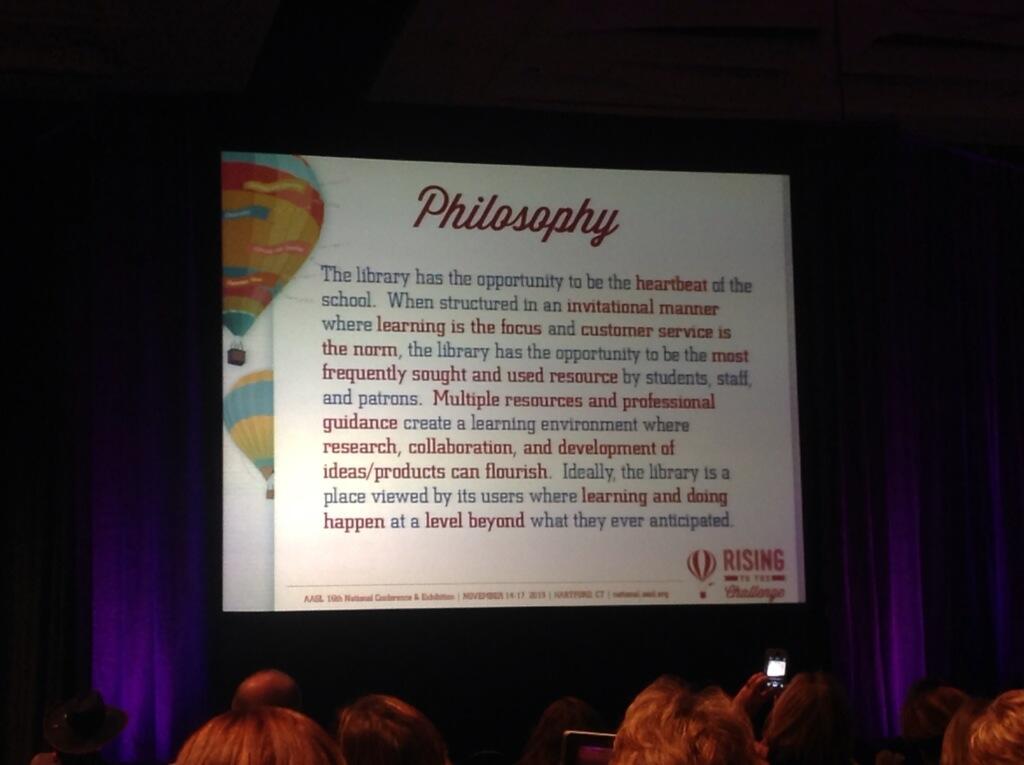
I just returned from a wonderful, inspiring event, the biennial convention of the American Association of School Librarians (AASL), a division of the American Library Association (ALA). Two of the highlights for me included the "Treasure Mountain" pre-conference, and a speech from Scott Bacon, principal of Blue Valley High School.  He told of the importance of collaboration with his school's media specialist, and even displayed a shared mission statement for the library. Wouldn't you want to work here?


But, the euphoria was interrupted when I got home after a fellow librarian pointed out a letter to the editor written about our State Superintendent, Glenda Ritz, in the Indianapolis Star, published online on November 15, and in print November 18.  Here is an excerpt:

Instead, let’s talk about the elephant in the room: We are being led by a librarian (media specialist)! Nothing against librarians (media specialists), but I have had many of them work for me over the years while serving as a school administrator. They are, as a group, wonderful people! However, they are trained to do a certain type of job and “leading” is not what they are trained to do. Nor are they knowledgeable about administrative legal issues and consensus building...We just need a leader in the superintendent’s office who knows something more than the Dewey Decimal System and how to follow orders from the unions

It turns out that the writer had been dismissed as a superintendent in Missouri in 2009 and now works as a realtor in Indiana, not licensed as an educator in our state.  Why does he perpetuate the "keeper of the books" perception? Has he even been in a library media center since 2009? After all, things have even changed a lot since then.  Many of today's library media specialists are among the most networked, collaborative, technologically-advanced teachers around, and I was just with over 2000 of them in Hartford. Making generalizations about an entire group of librarians seems as illogical as making assumptions about ...superintendents.

Members of our listserv were mad; boy, were we mad!  But, one of the aspects of media use we consider when working with staff and students: evaluate the source. Why was this published?  Ultimately, I think the Star probably hoped that this article would provoke the firestorm that it did. They are in the business of selling papers and delivering people to their website's advertisers.

Can I do more as a media specialist?  Absolutely, and I learned a lot in Hartford that I can use immediately.  I attended sessions on collaboration, web 2.0 tools, eBooks, literacy research, high-achieving students, virtual learning commons, technology integration, MakerSpaces, and much more.  I'm sure I will never meet this person who attacked our profession, but, at the end of the day, I don't do my job to prove people like him wrong; we choose and continue in our profession because we want to assist students and staff discover the joy of learning through any platform. We want them to be successful consumers, evaluators, and creators of information.  It is not about us. I think that is true leadership.

UPDATE: There have been several letters of support for Ritz in the Star since (and a few detractors). This letter on leadership came from Rachel Applegate, Chair of Library and Information Studies at IUPUI.

Monday, October 21, 2013

Sometimes the Memorex is Almost as Good

I've been waiting for George Couros's keynote from EDSCAPE at New Milford, NJ to be posted.  Thanks to TeacherCast, you can now watch it.

Do you ever sign up for webinars, telling yourself, well, if I can't watch it, they're sending me the archive? And do you ever watch the archive?  Well, this broadcast is worth watching after the fact.  There are so many inspirational, thoughtful reasons given to integrate technology and connect our students to others in the world.  I especially enjoyed Couros's family, personal stories, and how they relate to his journey as an educator. I have to admit, though, that it was fun watching live on Saturday knowing that many others across the country were joining from afar simultaneously.  I could tell from the tweets that there were many learning just from watching the twitter stream alone!  An interesting phenomenon happened when I saw @njtechteacher tweet live from New Milford and share her google doc notes; I could see her type as I watched Couros live.  She didn't realize it was being streamed until I commented on her helpful notes, complete with many references.

My favorite current webinars are Classroom 2.0 Live on Saturdays at noon ET, and many of the edWeb programs. What sets them apart?  In addition to outstanding guests, they have the most audience participation, with very active chat rooms. Seeing the archive is not as fun, but I almost always gain very valuable resources, and am inspired by the participants.

Watch the Couros keynote when you have time; I guarantee you will be inspired as well. Sometimes, you can be connected even after the fact.

Saturday, October 19, 2013

Connected Educator Month: Having a Great Time, but Ultimately "What We Have Here is a Failure to Connect"

Pretty lucky for me: our two-week break falls completely within Connected Educator Month. I've spent many hours attending webinars, participating in chats, attending the always-enjoyable Indiana Computer Educators (ICE) Conference (actually located in my district, but I may have been the only one of us there?), and, finally, resurrecting this blog.

Today is especially busy, as I attend sessions at the worldwide Library 2.0 Conference, the Discovery Educator Network (DEN) Virtual Conference  (How cool is this: if you agree to host a F2F event, they'll even reimburse you for lunch!), and EDSCAPE at New Milford High School in New Jersey. I watched the opening conversation at EDSCAPE via ustream, and then George Couros's inspiring keynote via TeacherCast.  I will post the link to Couros as soon as it is added to the TeacherCast youtube channel.  It's well worth watching; my stream kept breaking up, but I was finally able to see it all.  You sometimes have to be a little patient with the stream at these events. I hope that George Couros is booked to come to Indiana some time soon.


What if you're not "connected' yet?  Where do you start?  I know it can be overwhelming.  Just pick one thing.  I had a twitter account for a few years before I really "got it". I let this blog languish for years before others encouraged me to revive it.

The next challenge is to decide what to do with all of the information you accumulate.  How will you remember where you put it?  What makes it easiest to find? It's so easy to start a system, read about a new one, and then have pieces all over cyberspace. I've used livebinders, scoopit, diigo, google docs, and probably others I've forgotten.  Now I seem to be pinning things everywhere. For years I simply emailed links to myself and then searched my email (don't ask how many emails I still have) Don't worry about having the newest tool; just pick one and stick with it for awhile.

So, I have all of these outside connections, but what does that mean for my school? How do you share and collaborate with teachers who have an ever-expanding list of things they already have to do? How do you add "just one more thing"?  It doesn't matter how many things I've pinned, bookmarked, and saved unless something happens to them.

Yeah, I can be a connected educator, but if I don't complete the arc and make it reach students, it's all for naught.  What works for you?